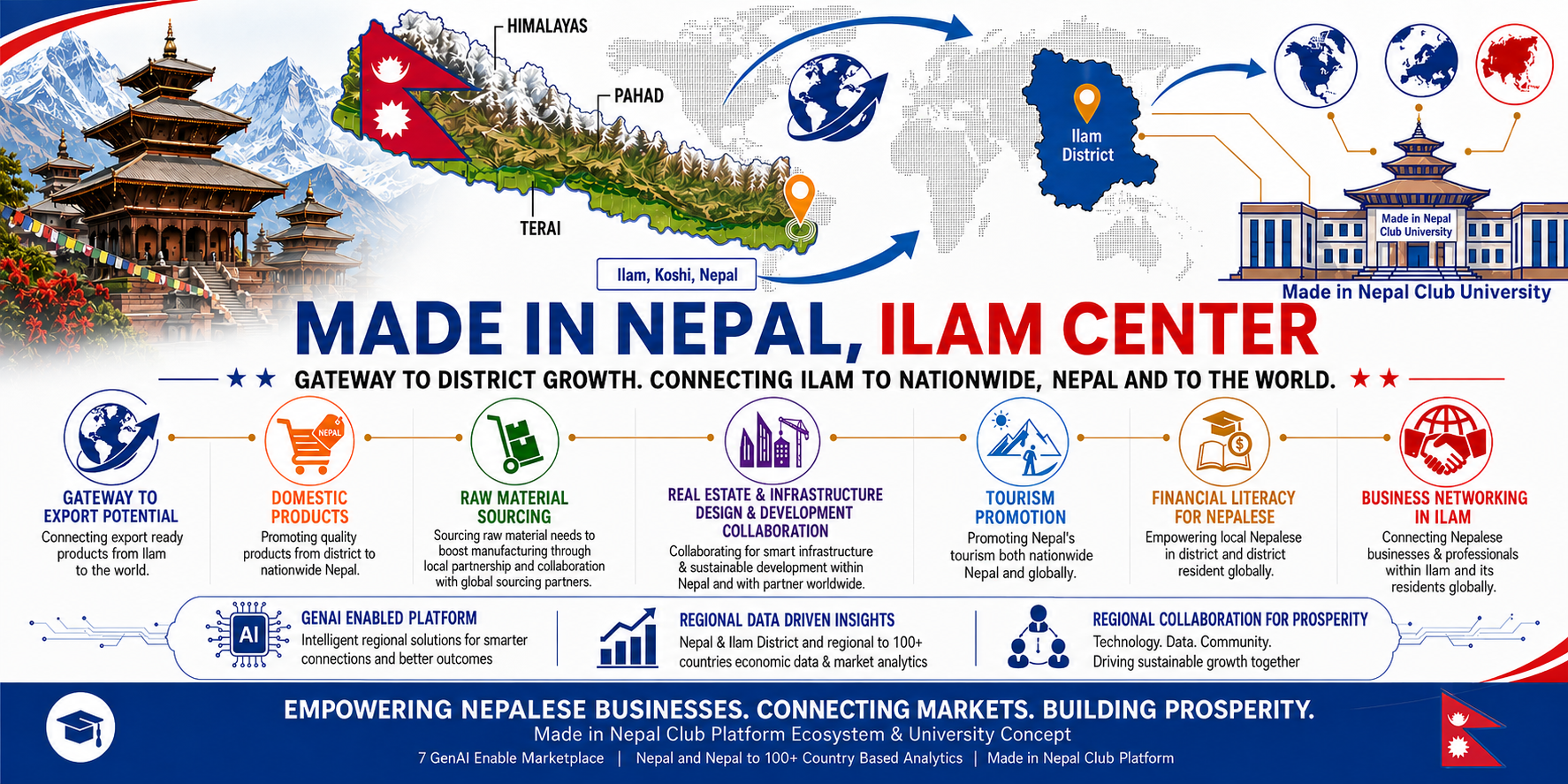
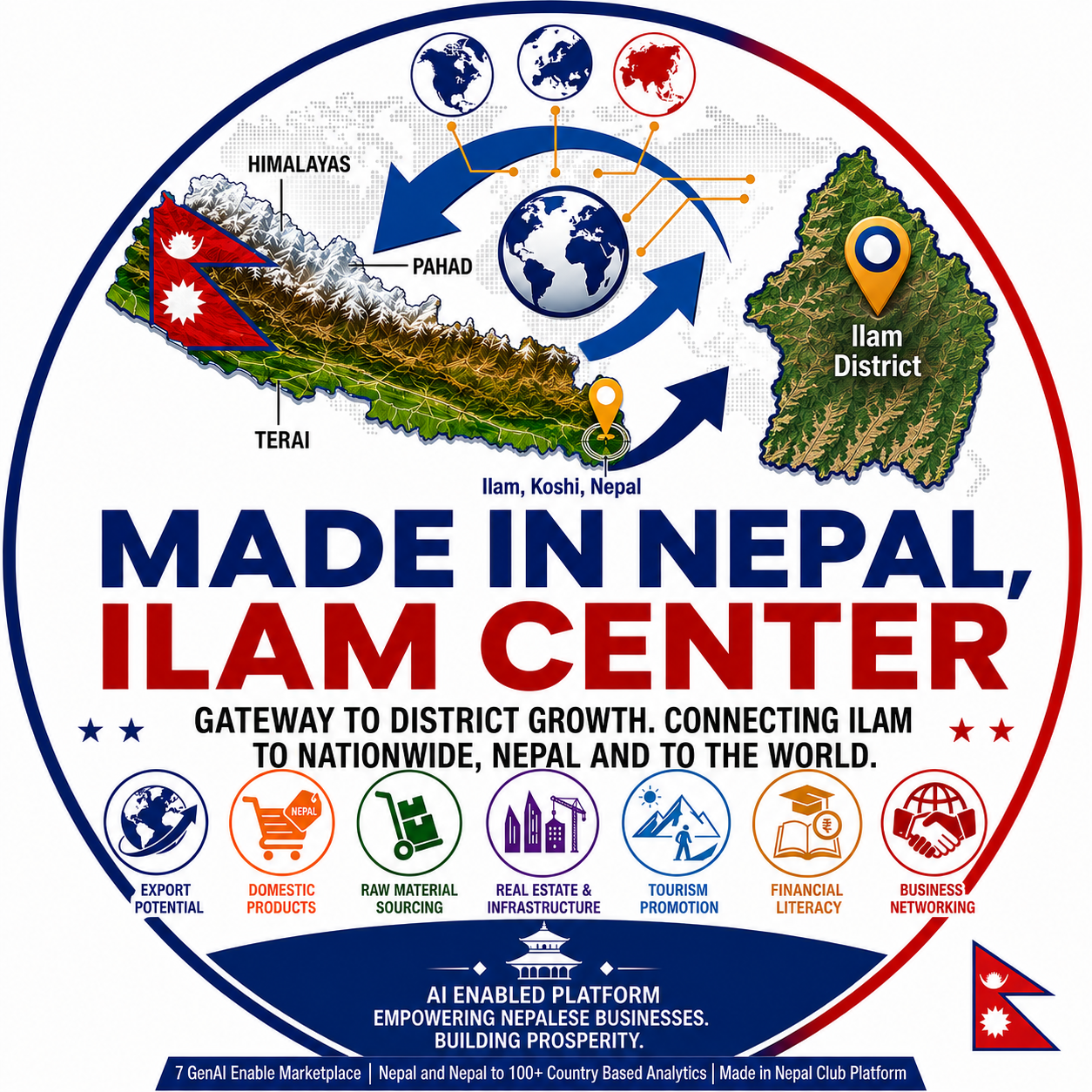
Gateway to Growth. Connecting Ilam to Nepal and the World.
VisitIlamNepal.com | International + Nepal Business Strategy Brief
Ilam Economic Gateway
From Nepal's Tea Capital to Nationwide Scale, Border Commerce, Experiential Tourism and Global Market Connectivity.
Strategic Research BriefSeptember 2026Ilam District, Koshi Province, Nepal
Gateway to Export Potential • Domestic Product Promotion • Raw Material Sourcing • Real Estate & Infrastructure Design & Development Collaboration • Tourism Promotion • Financial Literacy for Nepalese • Business Networking in Ilam, Nepal and to the World
A District Economy With Three Markets
Ilam should be developed through a three-ring commercial model: value creation inside the district, nationwide commercialization across Nepal, and global export/tourism/diaspora networks.
The district had 279,534 residents in the 2021 census across ten local governments. Nepal's Economic Census recorded 9,661 establishments and 26,804 persons engaged in Ilam in 2018, demonstrating a meaningful enterprise base.
Ilam's strongest economic identity is tea, reinforced by cardamom, ginger, akabare chilli, broom grass, dairy, specialty coffee and a major tourism landscape. Its eastern border with West Bengal and the Pashupatinagar customs point add a distinctive cross-border commercial dimension.
279,534District population, 2021
10Local governments
18,845Residents absent abroad, 2021
1,159 MTLarge cardamom output in current Koshi data
Seven Integrated Global Platforms
Each Pillar Must Benefit Ilam Locally, Nepal Nationally and Markets Globally
Every feasibility study should test three beneficiary layers rather than treating Ilam as an isolated district economy.
1. District Businesses
2. Nationwide Nepal
3. Global Buyers / Partners / Diaspora
1
Gateway to Export Potential
Prioritize orthodox and specialty tea, large cardamom, ginger, akabare chilli, broom grass, dairy/cheese, specialty coffee and selected natural products. Build aggregation, grading, traceability, packaging, certification, HS-code analysis and buyer validation before international scale-up. The National Tea & Coffee Development Board lists numerous Ilam processors producing orthodox and green tea, while Nepal Tourism Board notes Ilam tea already reaches markets in Europe and the U.S.
District: farmers, tea factories, cooperatives, processors. Nepal: wholesalers, hotels, exporters and e-commerce. Global: specialty tea/spice buyers, importers and diaspora consumers.
Market Research and Feasibility Study On:Gateway to Export Potential — Ilam to Nepal and the WorldView Market Research→
2
Domestic Product Promotion
Create a coherent Made in Ilam identity around tea origin, hill agriculture, dairy, craft and landscape. QR-based producer stories, professional packaging, tasting events, Kanyam/Fikkal showcases, provincial fairs, national retail partnerships and multilingual digital commerce can turn fragmented production into a visible market ecosystem.
District: producers, bazaars and local processors. Nepal: Kathmandu, Biratnagar, Itahari, hospitality and retail. Global: specialty stores, diaspora events and e-commerce.
Market Research and Feasibility Study On:Domestic Product Promotion — Made in IlamView Market Research→
3
Raw Material & Technology Sourcing
Evaluate disease-resistant planting material, irrigation, tea/cardamom dryers, grading, cold chain, dairy equipment, food processing, packaging, quality-testing systems, solar energy and digital tools. Use Nepal suppliers where competitive; source globally only when lifecycle productivity, quality or certification gains justify the additional cost and service requirements.
District: lower losses and higher quality. Nepal: suppliers, labs and technical institutions. Global: equipment, certification and know-how partners.
Market Research and Feasibility Study On:Raw Material & Technology SourcingView Market Research→
4
Real Estate & Infrastructure Design & Development Collaboration
Prioritize productive infrastructure: collection centres, cold storage, tea tasting/experience centres, processing facilities, eco-lodges, homestays, market sheds, broadband, water systems, resilient roads and border logistics. The Pashupatinagar Customs Office identifies the crossing as an important Nepal–India trade and movement point, creating opportunities for compliant logistics and market services.
District: MSMEs, farmers and tourism businesses. Nepal: developers, engineers, operators and financiers. Global: diaspora/investors and technical partners where projects are bankable.
Market Research and Feasibility Study On:Real Estate & Infrastructure Design & Development CollaborationView Market Research→
5
Tourism Promotion — Visit Ilam
Package Kanyam, Fikkal, Shree Antu sunrise, Mai Pokhari, Sandakpur, Ilam Bazaar, tea-factory visits, homestays, culture, birding and agro-tourism into bookable multi-day circuits. Nepal Tourism Board describes Ilam's tea gardens, forests, short hikes, sacred sites and cash-crop landscapes as the core destination proposition, with Bhadrapur serving as the main aviation gateway.
District: hotels, homestays, guides, transport, farms and retailers. Nepal: domestic travelers and tour operators. Global: tea, nature, culture and diaspora travelers.
Market Research and Feasibility Study On:Tourism Promotion — Visit IlamView Market Research→
6
Financial Literacy for Nepalese
Serve farmers, cooperatives, SMEs, students and migrant households with budgeting, bookkeeping, productive credit, insurance, digital payments, tax awareness, remittance planning, foreign-exchange risk and responsible investing. With 18,845 Ilam residents recorded abroad in 2021, productive reinvestment and returnee entrepreneurship should be central themes.
District: resilient households and businesses. Nepal: formal finance and enterprise capability. Global: migrant/diaspora capital and investment readiness.
Market Research and Feasibility Study On:Financial Literacy for Nepalese — Ilam Families, Entrepreneurs & DiasporaView Market Research→
7
Business Networking in Ilam, Nepal and to the World
Build verified directories of growers, tea processors, cooperatives, hotels, guides, traders, professionals and investors; connect them with buyers, banks, exporters, universities and institutions across Nepal; then map diaspora, global tea/spice buyers, travel partners and technology providers. This platform should become the connective infrastructure behind all six other objectives.
District: trusted referrals and B2B discovery. Nepal: buyer, finance and institutional matching. Global: buyers, mentors, investors, tourism and technology links.
Market Research and Feasibility Study On:Business Networking in Ilam, Nepal and to the WorldView Market Research→
The Strategic Business Window
Tea + Border + Tourism + Diaspora
Ilam's strongest opportunity is to connect quality agriculture → processing → brand → domestic distribution → export. Current Koshi Province data report approximately 1,159 MT of large cardamom from 1,691 ha, while the National Tea & Coffee Development Board lists a substantial network of Ilam orthodox and green-tea processors.
The district's eastern border with West Bengal creates a practical trade and visitor corridor through Pashupatinagar/Fikkal. That border advantage should be developed through compliant logistics, product aggregation, tourism information, buyer relationships and service businesses—not informal trade assumptions.
Tourism should be integrated with the product economy: a visitor can stay in a homestay, walk through tea gardens, visit a factory, taste tea, buy origin-labelled products, experience local food and continue to Antu, Mai Pokhari or Sandakpur. This converts landscape into an economic ecosystem rather than a photo stop.
Likewise, outward migration can become market connectivity. Ilam's global community can function as buyers, business mentors, destination ambassadors, technology scouts and investors when opportunities are transparent and professionally screened.
International + Nepal Business Strategy
VisitIlamNepal.com should function as more than a tourism site. It can become Ilam's integrated economic gateway—linking producers, processors, tourism businesses, municipalities, financiers, technology suppliers, national buyers and global partners under one market-development architecture.
LOCAL VALUE CREATION + NATIONWIDE DISTRIBUTION + GLOBAL MARKET ACCESS + TEA / AGRI-TECH + TOURISM + DIASPORA CAPITAL + B2B NETWORKS
Turning Ilam's Tea Identity Into Broader Economic Opportunity
VisitIlamNepal.com / Made in Nepal, Ilam Center can become a practical gateway connecting Ilam's tea growers, farmers, processors, tourism communities, youth and entrepreneurs with Nepal's domestic economy and with global buyers, visitors, investors, diaspora and technology partners.
Currency Standard: All financial figures on this platform should be displayed in Nrs and USD. For indicative conversion, this research uses the midpoint of Nepal Rastra Bank's 7 September 2026 rate: Nrs 150.88 buying and Nrs 151.48 selling, or approximately Nrs 151.18 = USD 1. Actual bank and transaction rates may differ.
Research & Information Disclaimer: This page is intended for general district economic-development, business, trade, tourism, infrastructure and financial-education information. It does not constitute legal, tax, engineering, customs, regulated financial or investment advice. Product markets, export programs, tourism concepts and infrastructure projects should undergo current technical, regulatory, market and financial feasibility review.
Research Published by Jay Sarraf, USA, Currently in Kathmandu,Nepal , Supported by The Raj Sarraf, USA